
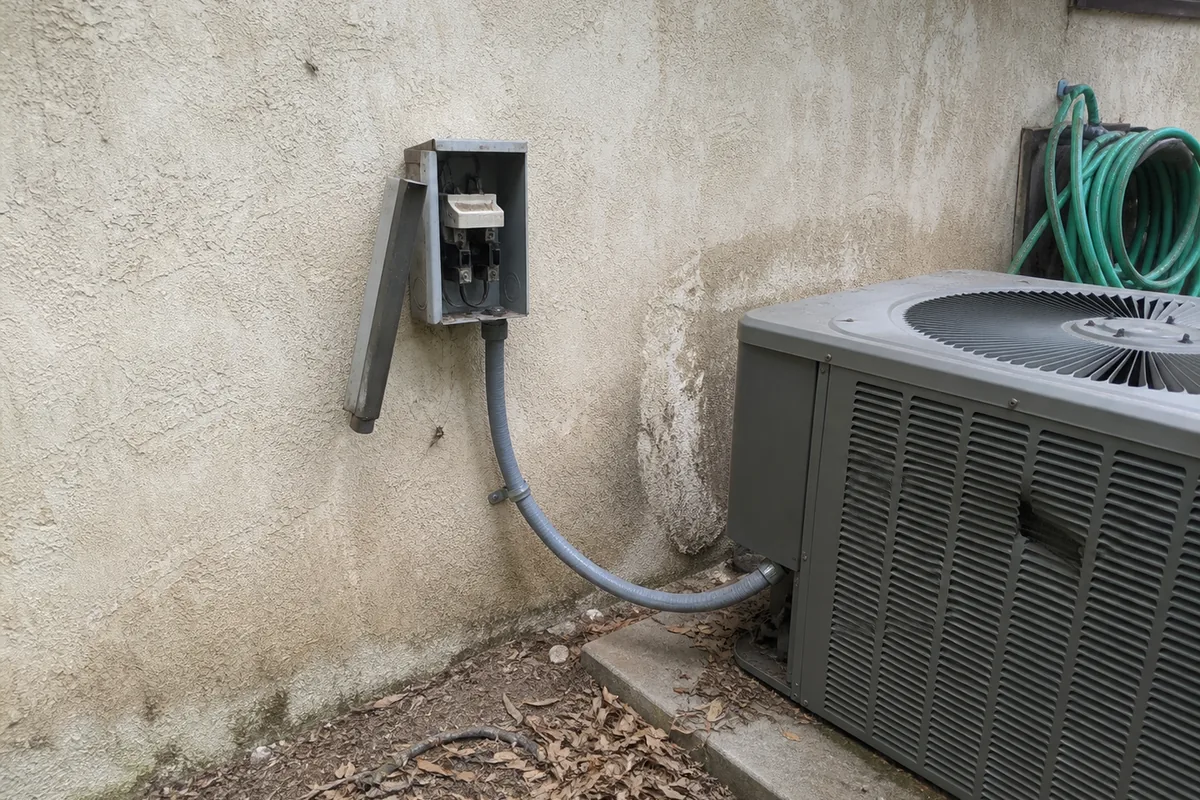
A condenser that keeps tripping its breaker is a callback you cannot fix at the equipment. The unit is fine. The wiring is fine. Something upstream is deciding there is a fault when there is not one, and the homeowner does not care about the distinction. They care that the house is hot and you were the last person to touch it.
That scenario has a code date attached to it now. Exception No. 2 to NEC 210.8(F), which allowed listed HVAC equipment to skip ground-fault circuit-interrupter protection, expired September 1, 2026. In jurisdictions enforcing that language without amendment, outdoor residential air conditioners and heat pumps fall under the GFCI requirement from that date forward. AHRI has asked NFPA to push the expiration to September 1, 2028, and that request is still in public comment, not decided.
For a lot of shops the practical answer will be “this does not apply to me.” That is worth knowing with certainty rather than assuming, because the way this rule gets triggered is not what most contractors expect.
What actually expired
Section 210.8(F) covers outdoor outlets in dwellings. The text NFPA issued as a Tentative Interim Amendment to the 2023 edition of the National Electrical Code, TIA 23-3, reads:
210.8(F) Outdoor Outlets. For dwellings, all outdoor outlets, other than those covered in 210.8(A), Exception No. 1, including outlets installed in the following locations, and supplied by single-phase branch circuits rated 150 volts or less to ground, 50 amperes or less, shall be provided with GFCI protection.
That same amendment added the exception that just lapsed:
Exception No. 2: GFCI protection shall not be required for listed HVAC equipment. This exception shall expire September 1, 2026.
Two details in the main paragraph do more work than the exception does.
The first is the word “outlets.” Under the NEC’s own definition, an outlet is any point on the wiring system where current is taken to supply utilization equipment. It is not limited to receptacles. A hardwired condenser fed from a disconnect is supplied by an outlet, which is why this section reaches equipment that has no plug on it anywhere.
The second is the sentence sitting directly above the exceptions: if equipment supplied by an outlet covered under this section is replaced, the outlet must be supplied with GFCI protection. That is the trigger that matters to a residential shop. This is not only a new-construction rule. In a jurisdiction enforcing the unamended section, a straight condenser changeout on a 1998 house pulls the existing outlet into the requirement.
Whether it reaches you depends on the edition your AHJ enforces
Section 210.8(F) entered the code in the 2020 NEC. The NEC is not federal law, it is a model code, and it binds you only in the edition your state or local jurisdiction has adopted, with whatever amendments they attached. Three separate things can put you outside this requirement.
Your jurisdiction is on a pre-2020 edition. The section does not exist there. The National Association of Home Builders, writing on August 13, 2026, counted eight states still enforcing editions that predate 210.8(F).
Your state amended or deleted the section. This is the common case. HARDI, the HVACR distributors’ association, published a list on July 15, 2026 naming sixteen states that have amended or deleted 210.8(F) as it applies to outdoor HVAC equipment: Arkansas, Connecticut, Georgia, Iowa, Louisiana, Maryland, New Hampshire, New Mexico, North Carolina, Ohio, Oklahoma, South Carolina, South Dakota, Texas, Utah, and Virginia. NAHB’s count is higher, at least nineteen states, because it also counts states that delayed or limited the requirement rather than removing it.
Your state adopted the code but the local AHJ has an enforcement policy on it. Less common, and not something to rely on without getting it in writing.
Add those together and a large share of the country sees nothing change this month. The shops that should care are in jurisdictions enforcing the 2020, 2023, or 2026 NEC with 210.8(F) intact. If you do not know which of those describes you, that is the one call to make this week, and the person to make it to is your electrical inspector, not your distributor.
What compliance looks like where it does apply
There are two device paths, and they are not the same product.
The first is a Class A GFCI built to tolerate the leakage current that modern equipment produces. A standard Class A device trips at 6 mA or less, per UL Solutions. That threshold is what inverter-driven compressors and their power electronics keep bumping into, which is the whole origin of the nuisance-tripping complaint. Devices marked HF are evaluated against high-frequency leakage and are meant to hold where a conventional Class A device lets go.
The second path is new in the 2026 NEC. Exception No. 3 permits a listed Class C special-purpose GFCI for listed HVAC equipment. UL Solutions describes a Class C SPGFCI as intended for circuits with no conductor over 300 V AC to ground where reliable equipment grounding or double insulation is provided, tripping in the range of 15 to 20 mA rather than at 6 mA. The higher threshold is what makes it compatible with equipment that a Class A device fights with. Class C devices are covered by UL 943C rather than UL 943.
If you go the Class C route, the exception carries a marking obligation. The disconnect serving the equipment has to be labeled: “Warning: Class C SPGFCI Protection Provided for HVAC Unit.” That label is part of the compliance, not a nicety, and an inspector who knows the exception will look for it.
The open question is supply. HARDI’s July 2026 piece said plainly that whether HF GFCI devices are widely available through distribution, and whether contractors can reliably get them, was still unresolved. Before you promise a customer a compliant install date, confirm the device is actually on a shelf you can reach.
The extension is real, and it is not decided
AHRI submitted Tentative Interim Amendment Log No. 1924 asking NFPA to move the Exception No. 2 expiration from September 1, 2026 to September 1, 2028, across the 2020, 2023, and 2026 editions. The substantiation is that manufacturers on both sides, HVAC and GFCI, need more time to produce products that work together.
ACCA filed comments supporting it on August 19, 2026, arguing that laboratory evaluation and field validation are not finished across the range of affected equipment. ACCA’s filing points to testing in which 5 of 12 GFCIs tripped below the applicable must-hold current above 60 Hz, and frames unintended loss of cooling as its own safety problem rather than a convenience issue.
The public comment period on TIA 1924 closes September 9, 2026, with a Standards Council decision after that. So the honest state of play is a gap: the exception has lapsed, and the request to un-lapse it is still being processed. Do not plan around an extension that has not been issued, and do not tell a customer the rule went away.
What to do this week
- Confirm the enforced edition. Ask your AHJ which NEC edition is adopted and whether the state amended 210.8(F). Get the answer in writing or from the state’s published amendments, not from another contractor.
- Check your changeout language. If the replacement trigger applies in your area, a like-for-like condenser swap can now require GFCI protection on the existing outlet. That belongs in the quote, before the truck rolls, not in a conversation on the driveway.
- Talk to whoever pulls your permits. If you sub the electrical, they may already be sourcing HF or Class C devices. If you do not, find out now what your supply house can get.
- Write the trip down. If a unit starts nuisance tripping after a GFCI is added, record the device make, model, and marking alongside the equipment model. That record is what turns a vague complaint into something a manufacturer rep can act on.
- Do not add protection that is not required. In an amended state, installing a GFCI the code does not ask for can create the exact callback everyone is trying to avoid.
The part that lands on your phone
Whatever your jurisdiction decides, the field version of this is a homeowner calling because the air conditioning stopped and the breaker will not stay in. Those calls do not arrive politely spaced out. They cluster on the first hot afternoon after an install season, and they arrive while your techs are already on jobs.
A tripping-breaker call also needs real triage, because “the unit is dead” and “the unit runs and then quits” point at different problems and different truck stock. Getting that detail captured on the first call, rather than a voicemail that says “call me back,” is the difference between one visit and three. That is the job Dial 72 does when nobody in the office can pick up. See how it works, or pricing if the after-hours version of this is already going to voicemail.
Quick answers
What expired on September 1, 2026? Exception No. 2 to NEC 210.8(F), which said GFCI protection was not required for listed HVAC equipment. The exception carried its own expiration date in the code text.
Does this mean every outdoor condenser now needs a GFCI? Only in jurisdictions enforcing an NEC edition that contains 210.8(F) without a state or local amendment removing it. Many states have amended it, and several are still on editions that predate the section.
Does it apply to a replacement, or only new work? Section 210.8(F) states that when equipment supplied by a covered outlet is replaced, the outlet must be provided with GFCI protection. Where the section is enforced unamended, changeouts are in scope.
What device satisfies it? Either a Class A GFCI suited to the equipment’s leakage characteristics, commonly marked HF, or under the 2026 NEC’s Exception No. 3, a listed Class C SPGFCI to UL 943C with the disconnect marked “Warning: Class C SPGFCI Protection Provided for HVAC Unit.”
Is the exception coming back? AHRI’s TIA 1924 asks to extend it to September 1, 2028. Public comment closes September 9, 2026, and the NFPA Standards Council rules after that. Until it is issued, the exception is expired.
Who do I ask? The authority having jurisdiction for your area. Adopted edition and state amendments are the only two facts that determine whether any of this reaches your next install.
