
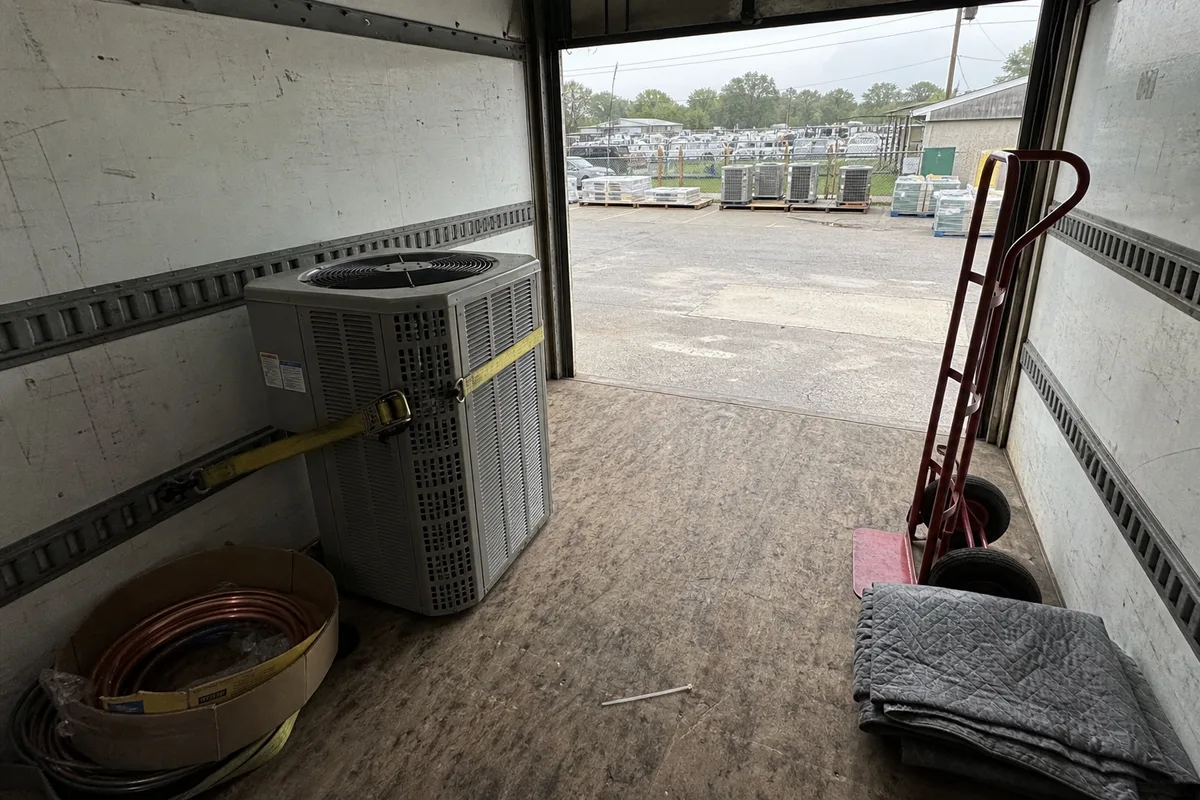
If you install residential equipment, you move charged refrigerating machines every single day. A condenser goes in the truck at the supply house and comes out on a driveway. Nobody has ever thought of that as a hazmat question, because for thirty years it was not one worth thinking about.
Then the charge changed. R-410A is a non-flammable gas for transport purposes. The A2Ls that replaced it, R-454B and R-32 among them, are not. The moment your inventory turned over, a routine part of the day quietly landed on a different page of the federal rules, and most shops never got a clear answer about where.
In August, PHMSA gave one. Two final rules, one effective August 19, 2026 and one effective September 3, 2026, extend exceptions that already covered R-410A equipment to cover A2L equipment as well. The short version is good news. There is one new condition attached to the larger of the two, and it is about how your truck is built.
The direct answer, first
A refrigerating machine, including an air conditioner or a heat pump, and its components such as precharged tubing, containing 20 kg (44 pounds) or less of a Group A2L refrigerant is not subject to the hazardous materials regulations when it moves by highway or rail. That is the effect of the amended exception at 49 CFR 173.307(a)(4)(iv), which took effect August 19, 2026.
Not “subject to reduced requirements.” Not subject to the regulations at all. No shipping paper, no marking, no placard, no hazmat training obligation attaching to the driver on account of that machine.
Almost all residential split system and packaged equipment is comfortably under 44 pounds of factory charge. Read the data plate on the units you actually stock rather than taking anyone’s word for it, including this article’s, but for a typical residential fleet that one sentence answers the question the whole shop has been half asking since the changeover.
What the two rules actually are
They are separate rulemakings published the same day, and they do different things. Mixing them up is the easiest mistake here.
HM-268M, adopting Special Permit 21287. Docket PHMSA-2025-0101, RIN 2137-AG15, published August 4, 2026, effective August 19, 2026. This is the one that amends 173.307(a)(4)(iv), the not-subject-to-the-regulations exception described above.
HM-268N, adopting Special Permit 21379. Docket PHMSA-2025-0102, RIN 2137-AG16, published August 4, 2026, effective September 3, 2026. This one amends 173.306(e), the limited quantity provisions for refrigerating machines, and it is where the new condition lives.
Both work the same way structurally. An exception already existed for machines charged with Group A1 refrigerant, meaning the R-410A world. Each rule extends that same exception to a flammable, non-toxic refrigerant gas in Category 1B under the Globally Harmonized System, or a Group A2L refrigerant gas under ANSI/ASHRAE Standard 34. PHMSA also updated the incorporation by reference in 171.7 to pick up ASHRAE Standard 34-2024 and the ninth revised edition of the GHS.
Read plainly, the agency’s position is that an A2L-charged machine should travel under the same terms as an A1-charged machine. That is a sensible outcome and it is the outcome the industry asked for.
The bigger exception, and the condition that is new
The 173.306(e) rule matters when you are above the 44 pound line. That is not most residential condensers, but it is light commercial equipment, larger packaged units, and any time you are hauling several charged machines together.
Under the amended 173.306(e)(1), a single vessel may hold up to 5,000 pounds of Category 1B or Group A2L refrigerant, with an aggregate limit of 2,000 pounds where a shipment involves multiple vessels. Machines that qualify are excepted from the specification packaging requirements. The conditions that come with it are the familiar engineering ones: a pressure relief device meeting ANSI/ASHRAE Standard 15, pressure vessels built to Standard 15 or, above 6 inches internal diameter, to Section VIII of the ASME Code, and all parts subject to refrigerant pressure tested per Standard 15. Those apply to how the machine was manufactured, not to anything you do on a Tuesday morning.
Here is the one that does apply to you. The amended rule adds a new subparagraph (ix) covering machines that contain a Division 2.1 gas, which is where an A2L charge lands in DOT’s classification system. Such machines must be transported one of three ways: on a motor vehicle using an open flat-bed trailer, on an open flat-bed rail car, or in a well-ventilated closed transport vehicle.
That third option is the one a residential shop will use, and it is worth sitting with. A fully enclosed cargo van or box truck with no meaningful ventilation is not obviously a well-ventilated closed transport vehicle. An open flat-bed or a stake body is not in question. A box truck with roof vents, a working louvered vent, or a practice of running with the door cracked is a different conversation than a sealed van used as a rolling warehouse.
The rule does not hand you a CFM number, and neither will this article. What it does is put ventilation into the text as a condition of the exception, where it was not before. If you routinely haul A2L equipment above the 173.307 threshold in a sealed box, that is now a question worth answering deliberately rather than by default.
Bulk refrigerant is a different animal
This is the distinction to hold onto, because it is the one that will get muddled at the counter.
All of the above is about refrigerating machines: equipment with refrigerant sealed inside it as part of a system. Jugs are not machines. A cylinder of R-454B riding in your van is bulk hazardous material in a pressure vessel, and none of these two rules touch it. That transport sits under its own set of requirements, which depend on the material, the packaging, the quantity, and how the vehicle is loaded.
The practical version: the condenser and the recovery cylinder in the same van are governed by two different regimes, and the friendly new answer applies only to one of them. If you have never had somebody actually read the cylinder side of the rules for how your trucks are loaded, this is a reasonable prompt to do it. Do not extrapolate the 44 pound figure across to jugs. It does not go there.
Used equipment coming back off a job
There is a second useful piece in the September 3 rule, and it lands on the changeout truck.
The limited quantity provisions in 173.306(e)(2) cover reconditioned or used refrigerating machines. Historically the marking exception in that paragraph was written around UN2857, the Division 2.2 entry for machines containing non-flammable gas. The amended rule extends it to UN3358, which is the Division 2.1 entry for refrigerating machines containing a flammable, non-toxic liquefied gas, and that is the entry an A2L machine falls under.
The exception from the marking requirements of 172.302(c) is conditioned on the machine meeting the (e)(1) requirements and being secured or permanently attached to the motor vehicle. That securing condition is not a formality. It is a requirement written into the relief, and it happens to be the same thing you should be doing anyway with a unit riding in a truck.
What none of this changes
Three things worth saying plainly, because deregulatory headlines invite over-reading.
It does not change anything about servicing. EPA Section 608 certification, recovery equipment certified for flammable refrigerant, A2L-appropriate tooling and leak detection, and whatever your manufacturers require for warranty standing are all untouched. These are transport rules.
It does not change storage. What you may keep at the shop, in what quantity, with what ventilation and separation, comes from your adopted fire and mechanical codes and from workplace rules, and those are local and vary. A federal transport exception is not a storage answer.
It does not reach air or vessel transport. Both exceptions are written “except when offered or transported by air,” and the 173.307 one excludes vessel as well. PHMSA acknowledged in the rulemaking that this leaves air and vessel moves to be handled case by case through special permits, which is a real complication for anyone shipping equipment to Alaska, Hawaii, or an island market. If that is your supply chain, do not assume the relief travels with the freight.
What to do this week
- Read the data plate factory charge on what you actually stock. If your residential lineup is under 44 pounds, the 173.307 exception covers it and the question is closed for those units.
- Sort your fleet into machines and jugs. They are governed differently. Anyone who thinks one rule covers the whole van has it wrong.
- Look at how your enclosed trucks breathe. If you haul larger A2L equipment in a sealed box, the new (ix) condition is a reason to look at vents now rather than after somebody asks.
- Strap the takeout. The used-machine marking relief is conditioned on the unit being secured or permanently attached to the vehicle.
- Do not let this leak into the cylinder conversation. If your transport practice for bulk refrigerant has never been properly reviewed, this rule did not review it for you.
The version that reaches your phone
None of this arrives as a regulatory question either. It arrives as a Tuesday where a tech is at a supply house sorting out what is going in the truck, the install crew is behind, and the office phone is ringing with a customer who wants to know when somebody is coming.
Replacement season overlaps with the first no heat calls, and that overlap is exactly when a shop runs out of people to answer a phone. A caller who gets voicemail during it does not usually leave a message. They call the next company on the list, and you never learn the job existed. Capturing what the equipment is doing and whether this is an emergency or a quote, on the first ring, is the whole difference. That is the job Dial 72 does when your office cannot pick up. See how it works, or pricing if the overflow version of that Tuesday is currently going to voicemail.
Quick answers
Can I haul an A2L condenser in my truck without hazmat paperwork? If the machine contains 20 kg (44 pounds) or less of a Group A2L refrigerant and it is moving by highway or rail, the amended exception at 49 CFR 173.307(a)(4)(iv) makes it not subject to the hazardous materials regulations. That took effect August 19, 2026.
Does that cover linesets? The exception at 173.307(a)(4) is written to cover refrigerating machines, including dehumidifiers and air conditioners, and components thereof, such as precharged tubing.
What about a cylinder of R-454B? Not covered. These rules address refrigerating machines, not bulk refrigerant in a cylinder. Cylinder transport is governed separately and the 44 pound figure does not carry over to it.
What is the new ventilation requirement? Under 173.306(e)(1)(ix), effective September 3, 2026, a refrigerating machine containing a Division 2.1 gas moving under the limited quantity provisions must travel on an open flat-bed trailer, on an open flat-bed rail car, or in a well-ventilated closed transport vehicle. It applies to the 173.306 exception, not to machines already excepted under 173.307.
Does this apply to air freight? No. Both exceptions carve out air, and the 173.307 exception carves out vessel as well. Those moves still need to be handled separately.
Where do the numbers come from? PHMSA final rules HM-268M (docket PHMSA-2025-0101, RIN 2137-AG15) and HM-268N (docket PHMSA-2025-0102, RIN 2137-AG16), both published August 4, 2026, adopting DOT special permits 21287 and 21379 into 49 CFR parts 171 and 173.
